Skip to content

AEO funnel · agency proposals

Proposal automation for marketing agencies

Proposal automation should shorten the path from inbound opportunity to a sharp, relevant first proposal without turning the agency’s positioning into boilerplate.

Best fit for agencies creating repeated proposals with similar structure, recurring scope components, and too much senior time spent assembling the first draft.

The short answer

What matters most.

The best proposal workflow prepares the structure, reuses known scope logic, surfaces missing inputs, and drafts the first version so the strategist spends time on positioning rather than repetitive assembly.

  • Best fit: agencies writing repeated proposals with similar service logic and recurring scoping patterns.
  • Main outcome: less admin-heavy proposal prep and faster time to a solid first draft.
  • The page should sell relevance and speed, not generic auto-generated decks.

Why this matters now

AI is now part of everyday knowledge work, especially in writing and information assembly tasks.

Proposal automation is compelling because it targets repeated assembly work that agencies already know is wasting senior time.

Source · Microsoft Work Trend Index 2024
AI’s clearest gains come from improving repetitive information-heavy workflows.

Proposal drafting fits well because it has structure, repeated inputs, and an immediate commercial outcome.

Source · PwC AI Jobs Barometer 2024

Buyer fit

Best fit

  • • Agencies with recurring proposal formats and known scope modules.
  • • Teams where strategists keep doing too much repetitive proposal assembly instead of tailoring the highest-value parts.
  • • Operators who want faster response without lowering proposal quality.

Not the best fit

  • • Agencies whose proposals are radically bespoke every time.
  • • Businesses hoping a workflow will replace actual positioning and commercial judgment.
  • • Teams with no stable source material, service logic, or scoping pattern to automate against.

Breakdown

Where proposal time gets burned

In collecting discovery notes, reformatting past language, rebuilding scope sections, pulling standard case-proof, and reconstructing pricing logic that the agency already understands but has not systematized.

What the workflow should automate

Draft structure, reusable scope blocks, proof insertion, missing-input detection, and preparation of the first version. That leaves humans to shape the strategic angle and pricing nuance.

What should remain human

Positioning, commercial tradeoffs, client-specific tension, and any part of the proposal where the agency’s judgment is what makes the document worth buying from.

How to sell the page

Sell faster, sharper first drafts and less wasted strategist time. That is much more credible than promising “instant proposals with AI.”

What breaks first

  • • Senior staff spend too much time rebuilding known proposal structures.
  • • The gap between inquiry and first proposal is slower than it should be.
  • • Proposal quality varies too much depending on who assembled the first draft.

What the workflow should do

  • • Reuse known scoping and proof logic more systematically.
  • • Prepare strong first drafts faster without flattening positioning.
  • • Reserve senior time for commercial nuance rather than repetitive assembly.

Representative proof

This page stands on a distinct workflow, not just an agency audience label

The agency audience page establishes the market, but the stronger proof is the adjacent reporting-automation workflow and the broader agency-automation page. Together they show that the site already treats agency operations as repeatable systems, which makes proposal automation feel like a specific commercial workflow rather than another generic agency page.

Open the reporting-automation sibling page

FAQ

Will proposal automation make all our proposals sound the same?

Not if the workflow is scoped correctly. It should automate structure and repeated blocks while leaving positioning and final commercial nuance to the human team.

What inputs should the workflow use?

Discovery notes, service modules, pricing logic, relevant proof points, past proposal language, and the few client-specific inputs that should shape the first draft.

What is the best success metric?

Reduced time to strong first draft, less senior admin time per proposal, and more consistent proposal quality across the team.

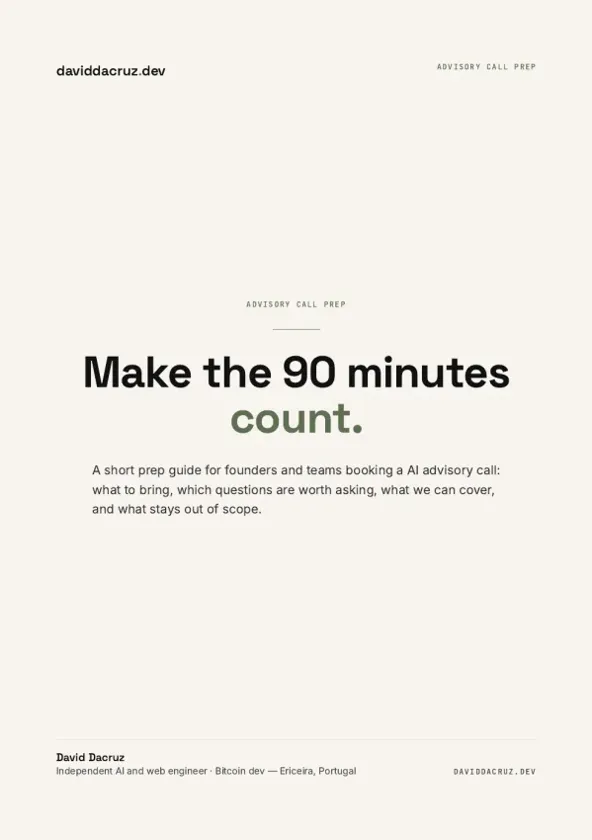
AI Advisory Call Prep Guide — PDF cover

Free PDF

AI Advisory Call Prep Guide

Make the 90 minutes count.

6 pages · PDF Inside:

  • A concise prep guide for founders
  • teams booking an AI advisory call: what to bring
  • which questions are worth asking
  • what we can cover
  • and what stays out of scope

Quick breakdown of the workflows, stack choices, and where the hours come back first.

Next step

Replies in ~24h

Want this mapped to your team and stack?

Use the advisory call to pressure-test the workflow, the handoff rules, and whether the first build should be a pilot or a production sprint.