AI productivity gains are strongest in repeated information work.
Agency reporting is one of the cleaner use cases because the structure repeats and the manual packaging cost is easy to see.
Source · PwC AI Jobs Barometer 2024AEO funnel · agency reporting
Agency reporting automation should reduce manual data gathering and packaging without flattening the client story into a generic dashboard export.
For agencies producing repeated monthly or weekly client reporting across similar channels, metrics, and narrative formats.
What I would check first
The right reporting workflow pulls the numbers, structures the highlights, flags anomalies, and prepares the draft narrative so humans spend time interpreting instead of compiling.
Why this matters now
AI productivity gains are strongest in repeated information work.
Agency reporting is one of the cleaner use cases because the structure repeats and the manual packaging cost is easy to see.
Source · PwC AI Jobs Barometer 2024AI is already becoming part of everyday knowledge work.
The buyer is looking for a more formalized reporting workflow, not another one-off prompt trick inside the team.
Source · Microsoft Work Trend Index 2024Fit check
Working notes
Data collection, normalization, anomaly surfacing, summary drafting, and packaging of recurring sections. That is where the repetitive cost sits.
Interpretation, client-specific nuance, strategy shifts, and any communication that requires judgment about what matters versus what merely changed.
They ask for “dashboards” when the real pain is the repeated assembly and narrative prep work around the dashboard. The workflow should attack the manual path, not only the final visual layer.
Sell time recovery, cleaner report prep, and more consistent client updates. These are outcomes agency owners can map directly to margin and delivery sanity.
What breaks first
What should change
Representative proof
Agency automation is strongest when it starts with a repeatable workflow. Reporting is a useful first target because the inputs, cadence, and business value are usually visible.
Open proof pageFAQ
Yes, if the workflow handles the repeated assembly work and leaves the strategist to shape the interpretation and recommendations that actually need human judgment.
The ones pulled every cycle with the least ambiguity: ad platforms, analytics, CRM metrics, and recurring narrative sections that follow a stable structure.
Sometimes, but not always first. Many agencies get most of the value from automating prep, anomaly detection, and draft summaries before automating the final format layer.
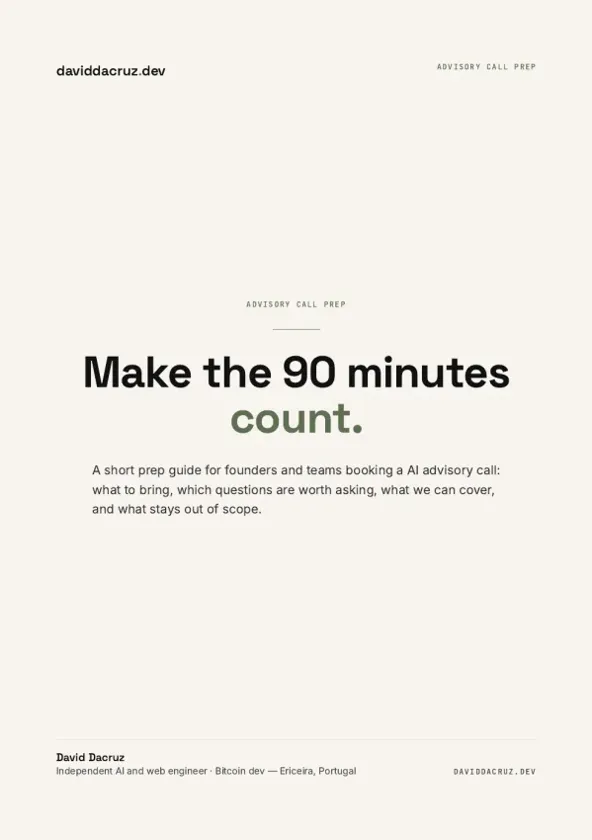
Free PDF
AI Advisory Call Prep Guide
Make the 90 minutes count.
6 pages · PDF Inside:
Quick breakdown of the workflows, stack choices, and where the hours come back first.