AI is already deeply present across knowledge work.
Agency buyers are not looking for a philosophical case. They want repeated internal work turned into something more scalable and less senior-time-heavy.
Source · Microsoft Work Trend Index 2024AEO funnel · agency workflows
Marketing agencies do not need more AI experiments. They need manual client work compressed into cleaner systems so senior time goes back to thinking and delivery.
For agencies with repeatable reporting, proposal, research, or content operations that keep stealing time from billable or strategic work.
Quick read
The best agency automation projects remove repeated production and coordination work while keeping strategic judgment and client communication standards visible.
Why this matters now
AI is already deeply present across knowledge work.
Agency buyers are not looking for a philosophical case. They want repeated internal work turned into something more scalable and less senior-time-heavy.
Source · Microsoft Work Trend Index 2024AI productivity improvements are especially visible in information-heavy sectors and roles.
Agency workflows like reporting, prep, research packaging, and proposal assembly are strong candidates because they are repeated, structured, and time-expensive.
Source · PwC AI Jobs Barometer 2024Should you bother?
What I would inspect
Monthly reporting, repetitive prep, deck assembly, content ops, proposal tailoring, internal QA coordination, and the many small handoffs that make agencies feel busy even when the work itself is not strategically hard.
One repeated process with clear inputs, clear outputs, and a visible handoff to a human. Agencies win when the workflow shrinks admin and preserves quality, not when it adds an opaque layer to delivery.
Client strategy, nuanced positioning, stakeholder management, and judgment-heavy interpretation. Automation should protect these, not pretend to replace them.
Sell recovered senior time and cleaner internal operations. That is a much stronger commercial promise than “AI agency change program”.
What breaks first
What I would tighten
Representative proof
The existing agencies page is already framed around reporting, proposal, and content workflows. This solution page turns that broader story into a stronger commercial landing page with buyer qualification and CTA structure.
Open proof pageFAQ
Usually the one with repeated structure and obvious time cost: reporting, proposal prep, content packaging, or research assembly. Start where hours are easy to see and quality rules are already known.
That is the wrong framing for most agencies. The better question is whether the same team can spend more time on higher-value strategy and less on repetitive production work.
By automating the structured parts first, keeping review checkpoints visible, and avoiding attempts to automate judgment-heavy client communication too early.
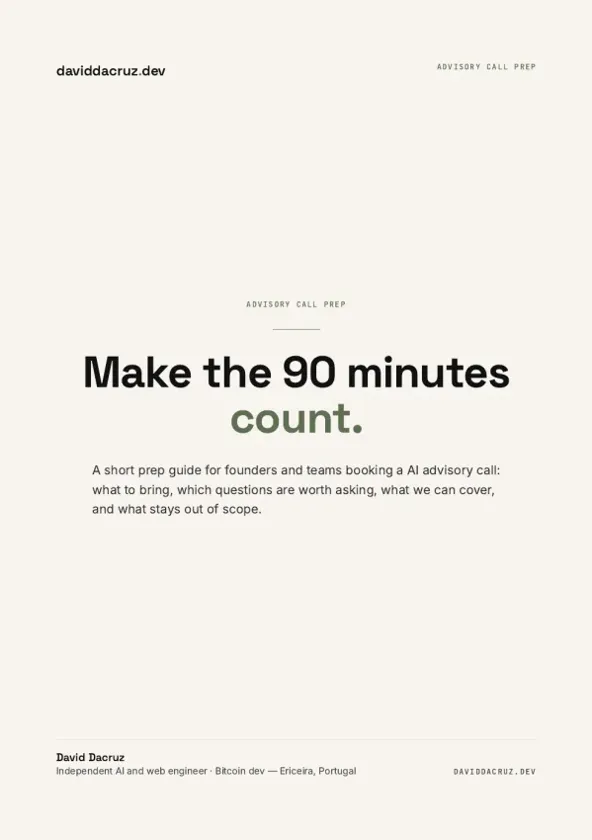
Free PDF
AI Advisory Call Prep Guide
Make the 90 minutes count.
6 pages · PDF Inside:
Quick breakdown of the workflows, stack choices, and where the hours come back first.