Structured data helps pages communicate explicit meaning.
Entity clarity is partly a schema problem, but also a visible-page problem around consistency and relationships.
Source · Google Search Central structured data guideEntity SEO for AI search
Entity SEO for AI search is about making the business, offer set, and page relationships legible enough that search systems can understand what you are, what you do, and which pages should represent you on specific questions.
For businesses with real expertise and useful pages whose brand, services, or topic authority still feel fragmented or weakly defined across the site.
What I would check first
This work reduces ambiguity around the business and its offers so the right pages are easier to trust, summarize, and recommend.
Why this matters now
Structured data helps pages communicate explicit meaning.
Entity clarity is partly a schema problem, but also a visible-page problem around consistency and relationships.
Source · Google Search Central structured data guideAI-search systems continue to rely on the same fundamental site-quality signals.
Entity work should be sold as clearer site meaning and trust, not as a magic shortcut.
Source · Google Search Central AI features guideFit check
Working notes
Clearer signals around who you are, what you offer, what topics you own, and how your proof, service pages, and supporting pages fit together.
Mixed terminology, weak About and service-page connections, weak schema, scattered proof, and supporting pages that do not clearly reinforce the right offer.
AI search is more likely to trust pages when the business and offer set are easier to interpret as a coherent whole.
A fragmented site makes even good pages feel weaker. Better entity clarity makes the brand and the offer graph easier to trust.
What breaks first
What should change
Representative proof
The search cleanup case study already includes entity cleanup as part of the work. This page makes that layer explicit for buyers who already suspect their site feels semantically fragmented.
Open the AI search structure proofFAQ
No. Schema helps, but the visible page structure, terminology consistency, proof links, and parent-child relationships matter too.
Usually when the site has enough pages and proof that ambiguity is now the main search constraint.
Yes, because clearer entity signals usually improve how consistently the business and its offers are represented across the site.
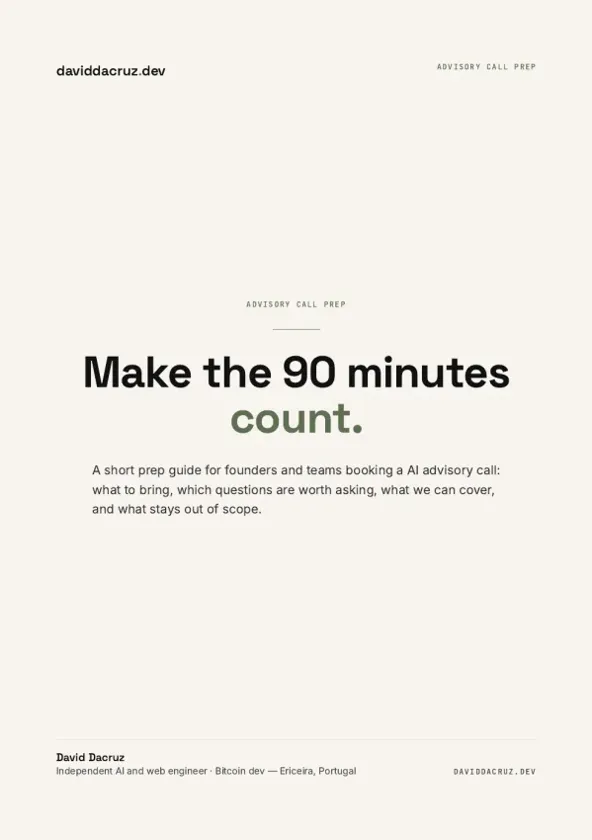
Free PDF
AI Advisory Call Prep Guide
Make the 90 minutes count.
6 pages · PDF Inside:
Quick breakdown of the workflows, stack choices, and where the hours come back first.