Skip to content

Agent search optimization

Agent search optimization

Agent search optimization makes your site easier for Google, AI search, and answer engines to understand and route to the right page. If you searched for agent engine search optimization, the practical work is mostly the same: clearer page meaning, stronger schema, better internal links, and landing pages that answer the decision in front of the visitor.

For SaaS, services, and content-heavy sites with real buying pages already live, but weak page structure, weak schema, or weak internal linking around those pages.

What I would check first

Where I would put the first hour.

If you want better visibility in AI search, do not start by publishing 50 more pages. Start by making the pages that should win easier to understand, easier to compare, and easier to act on.

  • Your site may already answer the right questions, but the strongest pages are not being surfaced consistently.
  • Clearer service pages, comparison pages, pricing pages, schema, and internal links usually lead to better-qualified traffic.
  • Start by fixing the commercial pages that matter most before expanding the cluster.

Why this matters now

Google says AI search still depends on strong SEO fundamentals, and that clicks from AI-driven experiences can be higher quality.

The pitch should focus on structure and conversion readiness, not on claiming a separate secret AI tactic.

Source · Google Search Central AI features guide

Google describes structured data as explicit clues about page meaning and cites stronger search interaction in published examples.

Explicit page meaning is one of the most credible levers for making a site easier to understand and recommend.

Source · Google Search Central structured data guide

AI is increasingly embedded in knowledge work, which raises the odds that product and service discovery will continue to be shaped by machine-mediated answers.

The earlier your commercial pages become easier to parse and route, the more likely they are to benefit from that shift.

Source · Microsoft Work Trend Index 2024
Fit check

Usually right for

  • • SaaS, service, and content-heavy sites where page structure now matters more than page count.
  • • Teams that want traffic from AI search, AI Overviews, and answer engines to land on stronger commercial pages.
  • • Businesses willing to improve templates, schema, internal links, and page positioning instead of chasing shortcuts.

Less likely to help

  • • Very small sites with thin content, weak offers, or no real proof yet.
  • • Teams expecting AI search gains without tightening page meaning and site structure.
  • • Buyers looking for trend language instead of implementation-led SEO work.

Working notes

What agent search optimization actually means

It means your service pages, pricing pages, comparison pages, and proof pages are clear enough that a person and a crawler can tell what each page is for.

How this overlaps with agent engine optimization

Some people use phrases like agent engine optimization, agent engine search optimization, answer engine optimization, or AI search readiness. The label varies, but the work is the same: clearer page meaning, retrieval-friendly structure, and pages that still make sense after AI search sends someone there.

What usually needs fixing first

Vague intros, thin schema, weak internal links, and clusters where three similar pages are all trying to answer the same question.

What good looks like

One strong parent page, a few useful supporting pages, proof that backs the offer, and calls to action that match what the visitor is trying to decide.

Why this matters now

AI search does not reward vague sites. It rewards pages that are easy to interpret, easy to cite, and easy to route into the right next step.

What changes when this is done properly

Your search structure gets clearer, your commercial pages get stronger, and AI-driven discovery is more likely to land on pages with a clear next step.

What breaks first

  • • The site has useful pages, but it is still unclear which page should own which query.
  • • Important commercial pages are buried under broader content or poorly linked siblings.
  • • AI search is being discussed internally, but the site structure still does not reflect that priority.

What should change

  • • Strengthen the pages that should own the main commercial queries.
  • • Use supporting pages to narrow search intent cleanly instead of creating overlap.
  • • Connect structure fixes directly to proof, offers, and next-step CTAs.

Representative proof

This is the same work already being shipped on the site

The search cleanup case study, the technical SEO service, and the supporting AEO pages are not theory pieces. The pattern is simple: tighten page meaning, tighten schema, tighten internal links, then make the next step obvious.

Open AI search structure proof

FAQ

Is agent search optimization different from SEO?

It is SEO applied to AI search and recommendation surfaces. The work is still technical SEO, page structure, schema, internal linking, and better commercial landing pages.

Is this the same as agent engine search optimization?

Usually yes in practice. Some people say agent engine optimization, some say answer engine optimization, and some say agent search optimization. The wording changes, but the implementation work overlaps heavily: clearer page meaning, schema, internal links, support content, and stronger conversion paths.

Which pages should be fixed first?

Usually your core service page, your strongest comparison or pricing pages, and the proof pages that support them. Those are the pages most likely to win qualified search traffic first.

What is the best first step?

Usually an AI search readiness review or a focused implementation pass. That gives you a clear fix order before you spend time publishing more pages.

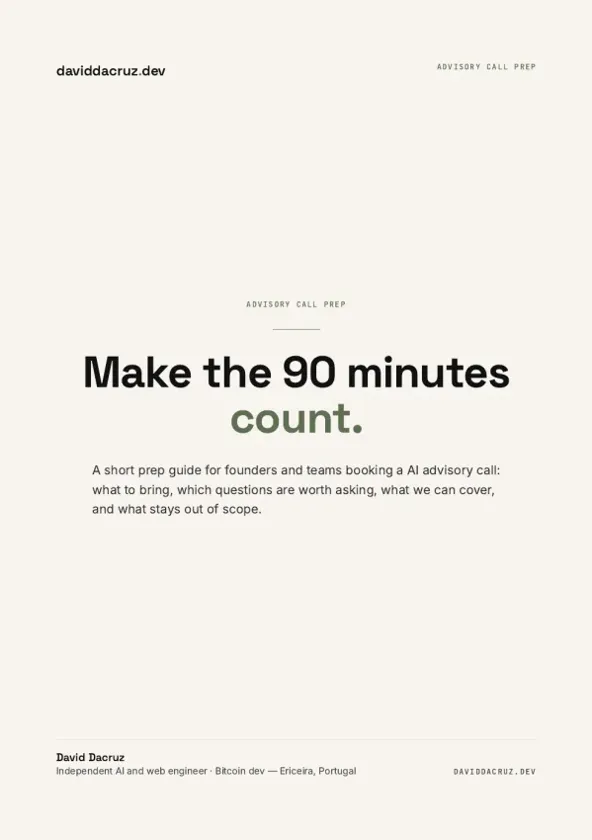
AI Advisory Call Prep Guide — PDF cover

Free PDF

AI Advisory Call Prep Guide

Make the 90 minutes count.

6 pages · PDF Inside:

  • A concise prep guide for founders
  • teams booking an AI advisory call: what to bring
  • which questions are worth asking
  • what we can cover
  • and what stays out of scope

Quick breakdown of the workflows, stack choices, and where the hours come back first.

Next step

Replies in ~24h

Need the search structure cleaned up before you publish more?

The review is the fastest way to see which pages should lead, which pages should support them, and which pages are only adding confusion.