Google’s AI-search systems still depend on useful pages and core SEO signals.
The diagnosis should start with page usefulness and structure, not trend-chasing.
Source · Google Search Central AI features guideAI Overviews diagnosis
If AI Overviews do not mention your site, the problem is usually not one hidden ranking trick. It is usually that the page is not clear enough, strong enough, or distinct enough to be trusted for that query.
For teams with useful pages already live but weak visibility in AI Overviews, answer engines, or AI search results.
The short answer
Start by checking whether the right page exists, whether it answers the query directly, and whether the site structure clearly supports that page.
Why this matters now
Google’s AI-search systems still depend on useful pages and core SEO signals.
The diagnosis should start with page usefulness and structure, not trend-chasing.
Source · Google Search Central AI features guideStructured data provides explicit clues about page meaning.
If the system is not reading your intent clearly, schema and visible page structure are worth inspecting together.
Source · Google Search Central structured data guideBuyer fit
Breakdown
The wrong page is targeting the query, several pages overlap, the intro does not answer the question directly, the proof is weak, or the rest of the site does not clearly support that page.
Check the title, H1, intro, short-answer block, schema, internal links, and the supporting proof. If those are weak, the page is harder to trust and harder to cite.
Better writing alone rarely fixes it. If the page role is unclear, the links are weak, or the surrounding cluster is messy, the system has less reason to choose that page.
One page clearly owns the query, nearby pages reinforce it, proof supports it, and the next step is obvious once the visitor lands.
The real question is simple: why is the page being skipped, and which fix is most likely to change that?
What breaks first
What the workflow should do
Representative proof
The search structure work is useful here because it shows the real fix pattern: clarify which page owns the topic, support it properly, and remove the ambiguity that makes machines skip over it.
Open the AI search structure proofFAQ
Usually no. The more common issue is that the page is not the clearest or strongest answer source for that query yet.
Only after checking that it is the right page to own the query. Sometimes the real problem is overlap, weak proof, or weak internal support around the page.
Yes. If multiple pages are trying to do the same job, it becomes harder for search systems to trust one of them as the clear answer.
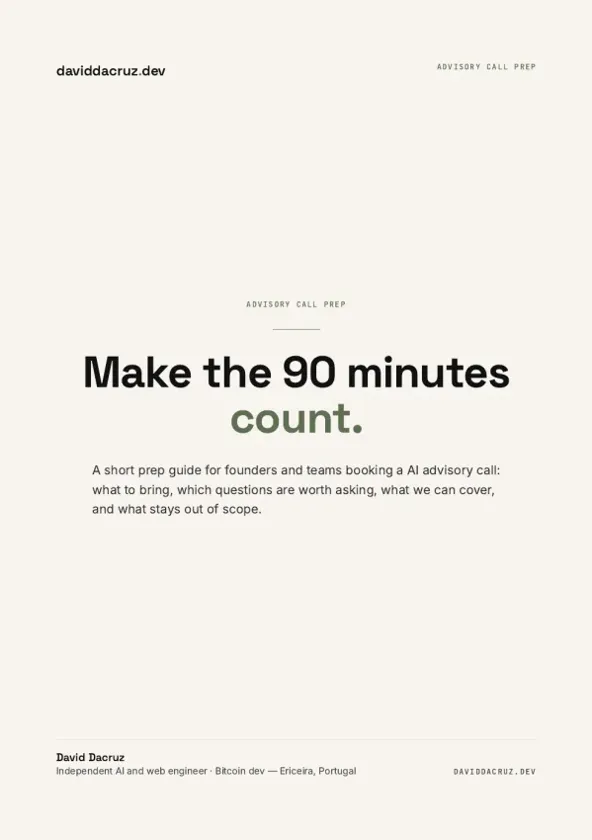
Free PDF
AI Advisory Call Prep Guide
Make the 90 minutes count.
6 pages · PDF Inside:
Quick breakdown of the workflows, stack choices, and where the hours come back first.