AI-search guidance still relies on core site quality and useful pages.
The checklist should focus on structural basics rather than speculative AI-only tricks.
Source · Google Search Central AI features guideAI search readiness checklist
An AI search readiness checklist is useful only if it points back to the real structural work: parent pages, child pages, schema, internal links, proof, and commercial CTAs.
For teams that need a fast way to understand whether their site is structurally ready before they expand the cluster or buy a deeper audit.
The short answer
Use the checklist to diagnose whether the site has clear parent pages, distinct long-tail children, decision pages, proof pages, and explicit structure. If several of those are missing, the next move is an audit, not more content.
Why this matters now
AI-search guidance still relies on core site quality and useful pages.
The checklist should focus on structural basics rather than speculative AI-only tricks.
Source · Google Search Central AI features guideExplicit clues help search systems interpret pages.
Schema belongs on the checklist, but only alongside visible page clarity and link structure.
Source · Google Search Central structured data guideBuyer fit
Breakdown
A clear main page, distinct supporting pages, cost and comparison pages, proof pages, schema, internal links, fit qualifiers, and clear next-step CTAs.
Whether the site is structurally ready to compound or whether more publishing would just create more overlap.
It gives the buyer a fast way to see whether the basics are in place before spending more time or budget expanding the site.
If several basics are weak, the next move is usually an audit or a focused implementation pass, not more content.
What breaks first
What the workflow should do
Representative proof
The AI search structure audit and case study already define the real work. This page gives buyers a quick way to self-identify the gaps before they book the deeper engagement.
Open the AI search readiness reviewFAQ
No. It is a triage tool. If several basics are weak, the review is what tells you what to fix first and what can wait.
Usually weak parent pages and unclear page jobs. If the site cannot explain which page owns which query, more content rarely helps.
Teams that already have several commercial and supporting pages live and need a quick structural read before expanding further.
Free PDF
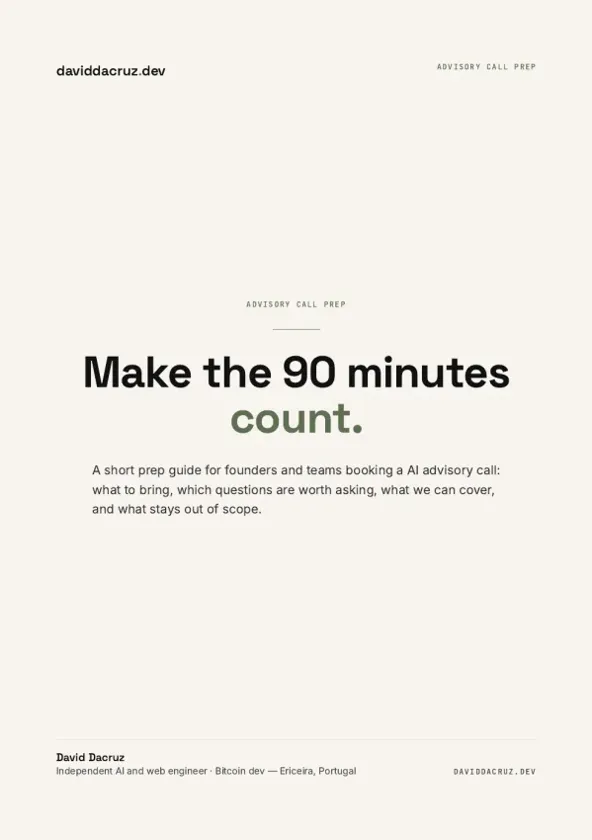
AI Advisory Call Prep Guide
Make the 90 minutes count.
6 pages · PDF Inside:
Quick breakdown of the workflows, stack choices, and where the hours come back first.