Skip to content

Prepare your website for AI search

How to prepare a website for AI search

Preparing a website for AI search is mostly technical and structural. The goal is to make the pages that matter easiest to understand, easiest to cite, and easiest to convert from.

Best fit for teams with service pages, pricing pages, comparison pages, product pages, or content clusters that already answer useful questions but still feel unclear or fragmented.

The short answer

What matters most.

If you want your website to perform better in AI search, start by strengthening your core pages, not by publishing more random ones.

  • This is most useful when a site already has valuable pages but weak hierarchy, weak schema, or weak internal linking.
  • The goal is clearer page roles, better AI-search visibility, and stronger entry pages for qualified visitors.
  • Start with the important pages you already have before creating more content.

Why this matters now

Google’s AI-search guidance still points site owners back to strong fundamentals and useful pages.

The practical preparation work is structural: clearer page meaning, better clusters, and stronger commercial landing pages.

Source · Google Search Central AI features guide
Buyer fit

Best fit

  • • Sites with enough existing content or service depth that structure is now more important than volume.
  • • Teams ready to improve templates, internal links, and schema on high-value pages.
  • • Businesses that want higher-quality search traffic, not just more impressions.

Not the best fit

  • • Very small sites with too few useful pages to form meaningful clusters yet.
  • • Teams expecting AI-search gains without improving visible page quality and relationships.
  • • Buyers looking for generic content generation instead of structural search work.

Breakdown

Which pages to fix first

Start with your main service page, your strongest comparison pages, your pricing or cost pages, and the proof pages that support them. Those are the pages most likely to matter in AI search.

What to tighten before you expand

Your title, H1, intro, schema, short-answer block, internal links, and CTA path. If those are weak, publishing more pages usually makes the site noisier, not better.

What preparation looks like in practice

Choose which page should own which query, remove overlap, strengthen the supporting links, and make sure the visitor always has a clear next step.

What most teams miss

They think preparing for AI search means writing “AI content”. Most of the time it means fixing page clarity, structure, and machine-readable signals first.

What you get from doing it properly

A site that is easier for machines to interpret and easier for qualified visitors to use once they land.

What breaks first

  • • Useful pages exist, but it is still unclear which page should rank or be cited for which topic.
  • • The site has grown without a clear structure around its most important pages.
  • • AI-search planning is happening before the site basics are fully in place.

What the workflow should do

  • • Prioritize the pages that should win commercial recommendation intent first.
  • • Strengthen parent-child cluster logic before publishing more variants.
  • • Tie schema, internal links, and CTAs back to the pages that should convert.

Representative proof

This is the same sequence already used on the site

The AI search-readiness audit and case study already show the real preparation path: clarify the page roles, tighten internal links, improve schema, and strengthen the commercial pages before expanding further.

Open the AI search readiness audit

FAQ

Should we publish more pages before doing this work?

Usually no. If your core pages are still weak or overlapping, more publishing usually creates more confusion before it creates more traffic.

Which pages matter most for AI search?

Usually your service pages, pricing pages, comparison pages, product pages, and proof pages. Those are the pages most likely to win high-intent search visibility first.

Is this separate from technical SEO?

No. This is technical SEO, internal linking, schema, and content structure applied to AI-powered search and answer engines.

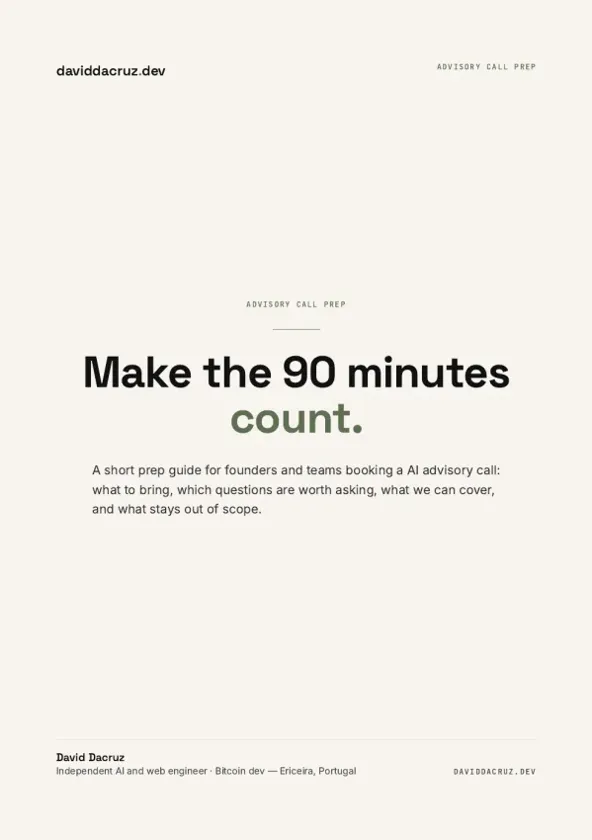
AI Advisory Call Prep Guide — PDF cover

Free PDF

AI Advisory Call Prep Guide

Make the 90 minutes count.

6 pages · PDF Inside:

  • A concise prep guide for founders
  • teams booking an AI advisory call: what to bring
  • which questions are worth asking
  • what we can cover
  • and what stays out of scope

Quick breakdown of the workflows, stack choices, and where the hours come back first.

Next step

Replies in ~24h

Want this mapped to your team and stack?

Use the advisory call to pressure-test the workflow, the handoff rules, and whether the first build should be a pilot or a production sprint.