Skip to content

Agent search optimization for SaaS

Agent search optimization for SaaS

Agent search optimization for SaaS helps your product, pricing, comparison, and support pages get understood faster and land visitors on pages that can actually convert. If your team is using the phrase agent engine search optimization, the practical SaaS work is still about structure, page meaning, schema, and internal links.

Best fit for SaaS teams with product pages, docs, pricing, comparisons, and support content that already attract research traffic but still feel weak as commercial entry pages.

The short answer

What matters most.

For SaaS, better AI-search visibility usually comes from better structure, better page meaning, better schema, and better internal links, not from publishing another wave of generic content.

  • This works best when a SaaS site already has real page depth but weak machine-readable clarity.
  • The gain is better visibility for product and workflow queries, plus better conversion from those visits.
  • The work is usually structural first: page roles, schema, internal links, and stronger commercial entry pages.

Why this matters now

Google says standard SEO best practices remain the foundation for AI-powered search features, and clicks from AI Overviews can be higher quality.

The commercial case is not a new secret tactic. It is stronger fundamentals combined with landing pages that qualify and convert better.

Source · Google Search Central AI features guide
Google treats structured data as explicit clues about page meaning and cites cases of stronger search interaction on enhanced pages.

For SaaS, agent search optimization should be framed as clearer machine-readable meaning, not only a copy rewrite exercise.

Source · Google Search Central structured data guide

Buyer fit

Best fit

  • • SaaS teams with product pages, docs, comparisons, pricing explainers, and support content that already attract research-heavy traffic.
  • • Organizations that want search traffic which arrives better qualified, not only larger in volume.
  • • Teams able to improve page structure, schema, internal links, and answer surfaces with engineering or consultant help.

Not the best fit

  • • Very early products with too little useful public information to structure yet.
  • • Teams wanting “AI SEO” without fixing technical clarity or page meaning.
  • • Buyers expecting answer-engine visibility to come from volume alone rather than stronger structure and relevance.

Breakdown

What SaaS sites need for AI search

Clear product and workflow pages, stronger pricing and comparison pages, useful support content, good schema, and internal links that make the page relationships obvious.

What usually breaks first

Docs grow in one direction, product pages grow in another, and pricing or comparison pages stay too weak. The result is lots of content and too few pages that clearly own buying intent.

What good looks like

A product or service page owns the main query, supporting pages narrow the intent, proof backs it up, and the CTA fits the stage of the visitor.

Why this matters commercially

Better AI-search visibility only matters if the person lands on a page that can move them toward a trial, a demo, or a meaningful next step.

What usually matters commercially

The goal is not another generic SEO retainer. The goal is product and revenue pages that are easier to find, easier to trust, and easier to act on.

What breaks first

  • • Important SaaS pages are still too vague or too weakly linked to win the right search intent consistently.
  • • High-intent product and workflow queries often land on weaker pages than they should.
  • • Search readiness work is split across product, SEO, content, and engineering with no clear owner.

What the workflow should do

  • • Clarify page meaning, relationships, and machine-readable structure.
  • • Create stronger answer surfaces for commercial product and workflow questions.
  • • Link discoverability improvements directly to landing-page conversion quality.

Representative proof

The search-readiness case study already shows the pattern

The useful proof is not abstract. When page roles, schema, support pages, and internal links become clearer, the strongest commercial pages become easier to route to and easier to convert from.

Open AI search-readiness proof

FAQ

Is agent search optimization different from normal SaaS SEO?

The foundations are the same, but the emphasis shifts toward explicit page meaning, clear answer surfaces, structured data, and landing pages that work when the visitor arrives partly pre-qualified by AI search.

Does this also cover agent engine optimization for SaaS?

Yes. The naming is inconsistent, but the practical SaaS implementation is largely the same: make product, pricing, comparison, workflow, and support pages easier for AI-mediated search systems to interpret and route.

Which SaaS pages matter most?

Usually product pages, workflow pages, pricing pages, comparison pages, support pages, and proof pages tied to real buyer questions.

How do we know this is working?

You should see stronger entry pages for commercial queries, better-qualified visits, and clearer movement from search landing to your actual next-step CTAs.

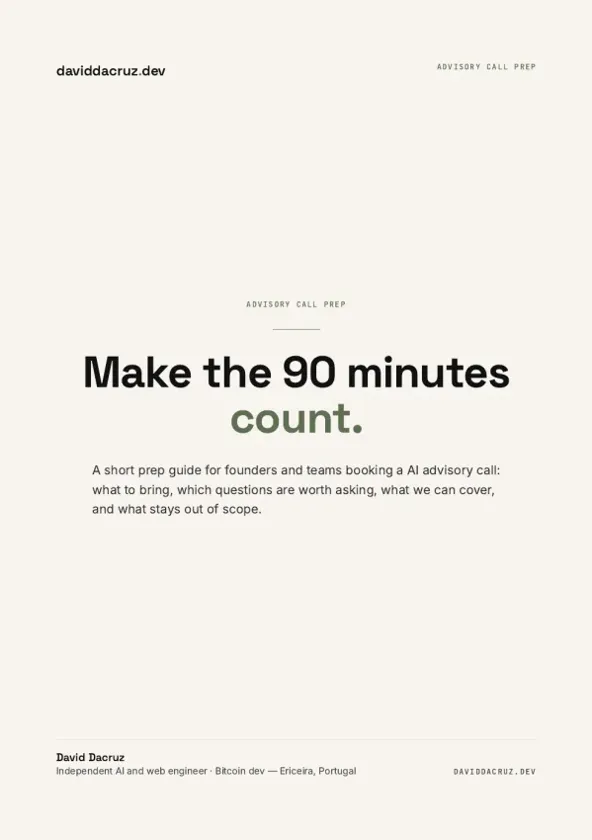
AI Advisory Call Prep Guide — PDF cover

Free PDF

AI Advisory Call Prep Guide

Make the 90 minutes count.

6 pages · PDF Inside:

  • A concise prep guide for founders
  • teams booking an AI advisory call: what to bring
  • which questions are worth asking
  • what we can cover
  • and what stays out of scope

Quick breakdown of the workflows, stack choices, and where the hours come back first.

Next step

Replies in ~24h

Want this mapped to your team and stack?

Use the advisory call to pressure-test the workflow, the handoff rules, and whether the first build should be a pilot or a production sprint.