Skip to content

AEO funnel · content architecture

Technical SEO consultant for content-heavy websites

On content-heavy websites, the problem is often not “more content.” It is that the publishing system keeps generating weak pathways, weak clusters, or weak machine-readable structure at scale.

Best fit for teams publishing large volumes of content, guides, comparisons, or landing pages where architecture and template quality now matter more than just output volume.

The short answer

What matters most.

A technical SEO consultant is worth hiring when the content engine is large enough that template quality, internal links, schema, and crawl discipline drive more upside than another round of topic ideation.

  • Best fit: content-heavy sites where publishing scale has outpaced structural quality.
  • Main outcome: cleaner architecture, stronger internal links, better schema, and less index waste.
  • This page should convert on implementation depth and system thinking.

Why this matters now

Google treats structured data as explicit page-meaning signals and cites stronger interaction on enhanced pages.

For content-heavy sites, machine-readable structure is part of the compounding moat, not a decorative extra.

Source · Google Search Central structured data guide

Google’s guidance says standard SEO best practices still apply for AI-powered search features.

The commercial case is stronger when the work is framed as search infrastructure for both classic organic search and answer-engine visibility.

Source · Google Search Central AI features guide
Buyer fit

Best fit

  • • Teams publishing many guides, comparisons, cost pages, or editorial hubs.
  • • Sites where internal links, taxonomy, schema, or template quality now matter more than another content brief.
  • • Organizations that need implementation-aware SEO help rather than only strategy decks.

Not the best fit

  • • Very small sites where the main issue is simply too little useful content.
  • • Teams wanting link building or content volume without fixing the underlying content system.
  • • Buyers looking only for reporting and not for change.

Breakdown

Why content-heavy sites break differently

One weak template or taxonomy decision can affect hundreds of URLs. That makes architecture, schema, canonicals, internal links, and crawl logic higher leverage than isolated page tweaks.

What a technical consultant should fix

Indexation issues, weak cluster structure, internal link dead zones, over-generated low-value pages, schema gaps, rendering problems, and template patterns that confuse both search engines and users.

Why this is an AEO problem too

Answer engines need explicit meaning, strong page relationships, and clear structured context. A content-heavy site without that structure is harder to cite reliably even when the raw content volume is high.

How to sell the page

Sell cleaner publishing systems and compounding discoverability. The buyer is paying to improve the whole content machine, not only one ranking report.

What breaks first

  • • Publishing scale has created weak clusters, weak internal links, or thin template sprawl.
  • • The site keeps adding content without enough structural compounding.
  • • Important pages are harder for search systems to interpret than they should be.

What the workflow should do

  • • Improve the content system, not only individual URLs.
  • • Use schema and internal links to make page meaning more explicit.
  • • Reduce wasted crawl and indexing attention across weak templates.

Representative proof

The search-readiness case study is the right proof bridge

The AI search-readiness case study already speaks to entity cleanup, schema, internal links, and machine-readable search surfaces. This page narrows that story to content-heavy buyers.

Open proof page

FAQ

What makes a site “content-heavy” in a technical SEO sense?

Usually a site with enough guides, landers, or editorial pages that template quality, taxonomy, and internal links start to matter more than any single page edit.

Is this mainly about Google or also about AI search surfaces?

Both. Clear structure, schema, and strong page relationships help classic search and answer-engine understanding at the same time.

What should be fixed first on a content-heavy site?

Usually the highest-leverage template and architecture issues: indexation waste, weak clusters, schema gaps, and internal-link patterns that undercut discoverability.

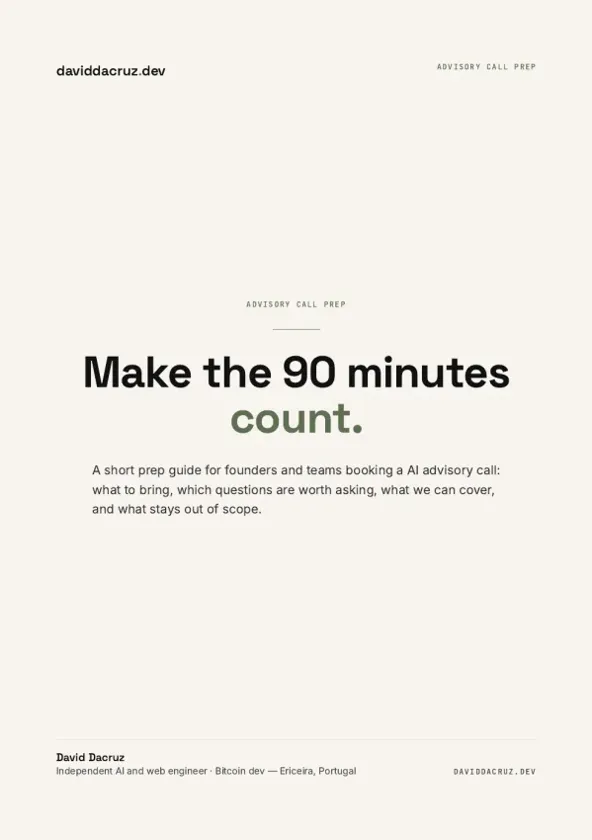
AI Advisory Call Prep Guide — PDF cover

Free PDF

AI Advisory Call Prep Guide

Make the 90 minutes count.

6 pages · PDF Inside:

  • A concise prep guide for founders
  • teams booking an AI advisory call: what to bring
  • which questions are worth asking
  • what we can cover
  • and what stays out of scope

Quick breakdown of the workflows, stack choices, and where the hours come back first.

Next step

Replies in ~24h

Want this mapped to your team and stack?

Use the advisory call to pressure-test the workflow, the handoff rules, and whether the first build should be a pilot or a production sprint.