Skip to content

AI search readiness for content-heavy websites

AI search readiness for content-heavy websites

On content-heavy websites, AI search readiness usually breaks because the content system is hard to interpret, not because the team has not published enough.

Best fit for sites with large libraries of guides, comparison pages, cost pages, or editorial hubs where the page count has outgrown the structure.

The short answer

What matters most.

If your site has hundreds of pages, the next win is usually not more output. It is making the existing system easier to understand, easier to navigate, and easier to surface in search.

  • This is most useful when architecture and page hierarchy have become the limiting factor on a content-heavy site.
  • The gain is stronger machine-readable structure and better routing of high-intent traffic.
  • The focus is content-system clarity, not another publishing sprint.

Why this matters now

Google’s AI search guidance still points site owners back to strong SEO fundamentals.

The clearest commercial message is better site structure and answer surfaces, not a separate AI-only publishing strategy.

Source · Google Search Central AI features guide

Structured data helps Google understand pages more explicitly and has shown stronger interaction in published case studies.

For content-heavy sites, schema and machine-readable clarity are part of the moat when many pages compete for interpretation.

Source · Google Search Central structured data guide
Buyer fit

Best fit

  • • Sites publishing many guides, comparisons, glossary pages, or landing pages at scale.
  • • Teams that suspect the content library is not structured cleanly enough for search systems to interpret well.
  • • Organizations wanting better AI-search visibility without creating more thin pages.

Not the best fit

  • • Small sites where the main issue is simply insufficient useful content.
  • • Teams expecting answer-engine visibility without improving page meaning and internal structure.
  • • Buyers mostly looking for link acquisition rather than on-site search clarity.

Breakdown

Why content-heavy sites struggle in AI search

As page count grows, weak templates, weak taxonomy, weak schema, and weak internal links create more ambiguity. The site gets bigger without becoming easier to understand.

What usually needs work

Clearer hub pages, clearer child pages, better comparison and cost pages, cleaner internal links, and better schema on the page types that matter most.

Why more publishing often makes it worse

If the structure is already weak, adding more pages usually creates more overlap before it creates more authority.

What a better system looks like

Fewer ambiguous pages, clearer page roles, stronger internal routes into the pages that matter, and a content library that feels organized instead of bloated.

What breaks first

  • • Too many pages compete without a clear relationship model.
  • • Important commercial or decision pages are not structurally distinct enough.
  • • Publishing scale has outpaced internal-link and schema discipline.

What the workflow should do

  • • Improve the content system so machines understand page purpose faster.
  • • Strengthen clusters around high-intent query patterns.
  • • Reduce structural ambiguity before creating more pages.

Representative proof

The search-readiness case study already supports this angle

The same readiness work applies here: clarify entities, tighten schema, improve internal links, and make the strongest pages easier to identify. This page just narrows that work to content-heavy sites.

Open proof page

FAQ

What is the first thing to fix on a content-heavy site for AI search readiness?

Usually the relationship model: internal links, taxonomy, schema, and which pages are meant to answer which high-intent questions. More publishing should come after that is clearer.

Does this mean we should stop creating new pages?

Not necessarily. It means new pages should come from a clearer structure and stronger templates rather than from a page-count goal.

How is this different from a normal content audit?

The emphasis is more on machine-readable clarity, answer surfaces, and page relationships that help both classic search and answer-engine discovery.

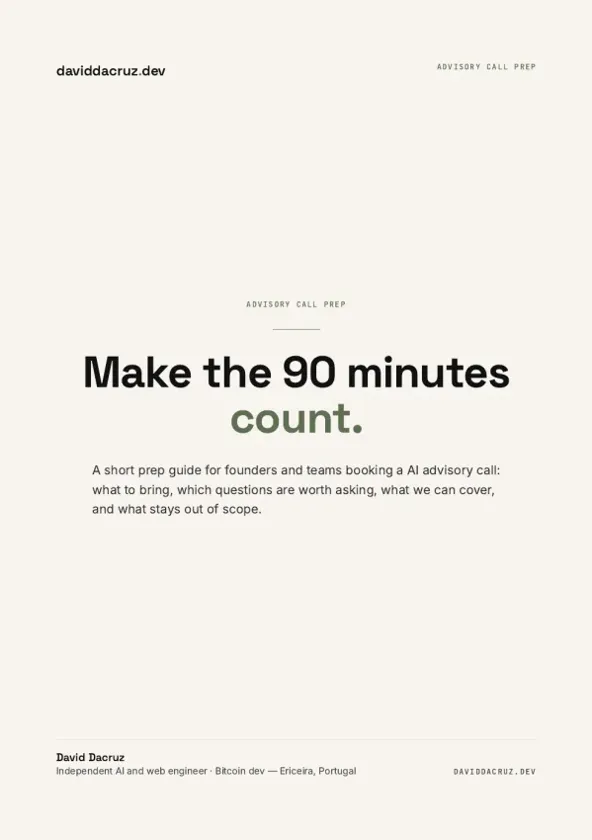
AI Advisory Call Prep Guide — PDF cover

Free PDF

AI Advisory Call Prep Guide

Make the 90 minutes count.

6 pages · PDF Inside:

  • A concise prep guide for founders
  • teams booking an AI advisory call: what to bring
  • which questions are worth asking
  • what we can cover
  • and what stays out of scope

Quick breakdown of the workflows, stack choices, and where the hours come back first.

Next step

Replies in ~24h

Want this mapped to your team and stack?

Use the advisory call to pressure-test the workflow, the handoff rules, and whether the first build should be a pilot or a production sprint.