Useful, direct answers remain central in AI search.
Comparison pages work well when they answer the tradeoff clearly instead of hedging around it.
Source · Google Search Central AI features guideComparison pages for AI search
Comparison pages are one of the strongest AI-search assets because they sit close to decision intent. If they are clear, direct, and well-linked, they can become recommendation-friendly entry pages for buyers evaluating options.
For businesses that already have comparison-style buyer questions but need stronger page structure and cluster support around them.
What I would check first
The best comparison pages for AI search state the tradeoff clearly, qualify the fit, link to the right parent and pricing pages, and connect the decision to a concrete next step.
Why this matters now
Useful, direct answers remain central in AI search.
Comparison pages work well when they answer the tradeoff clearly instead of hedging around it.
Source · Google Search Central AI features guideExplicit clues help search systems interpret page purpose.
Comparison pages benefit from cleaner structure, FAQs, and internal links that show where the decision should lead next.
Source · Google Search Central structured data guideFit check
Working notes
Clear tradeoffs, clear fit, clear recommendation, and clear links into the pricing, proof, and next-step pages.
They match high-intent evaluation queries closely, which makes them easier to summarize and easier to route when they are well structured.
They avoid taking a position, hide the recommendation, or fail to connect the decision to proof, pricing, or the next action.
Strong comparison pages help real buyers decide. Weak ones just add another page without moving the decision forward.
What breaks first
What should change
Representative proof
The existing comparison section shows the pattern: state the tradeoff, qualify the buyer, and route the next step. This page applies that structure to AEO clusters.
Open the comparison guidesFAQ
Usually yes, or at least clearly explain which type of buyer fits which option. Ambiguity makes the page less useful to both users and machines.
Usually the parent service page, the pricing or cost page, proof or case studies, and the CTA that matches the recommended next step.
Yes. For explicit evaluation intent, comparison pages are often closer to the user’s real question and can convert better if they are well-structured.
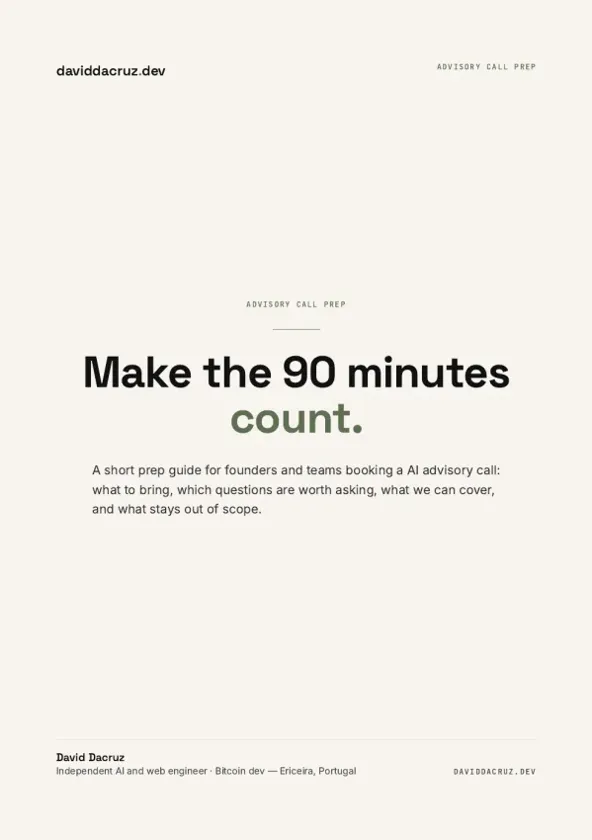
Free PDF
AI Advisory Call Prep Guide
Make the 90 minutes count.
6 pages · PDF Inside:
Quick breakdown of the workflows, stack choices, and where the hours come back first.