Skip to content

AI search audit for headless websites

AI search audit for headless websites

For headless websites, AI search readiness often fails for technical reasons before it fails for content reasons. The site may have useful pages, but rendering, metadata, schema, or template logic may still hide that value from search systems.

Best fit for headless or custom-stack sites where the commercial page model exists, but the stack may be undermining machine-readable clarity.

The short answer

What matters most.

The audit should inspect rendering, metadata consistency, canonical output, schema injection, page-type relationships, and whether the site’s commercial hierarchy is actually visible in the generated output.

  • This is most useful when the stack may be hiding otherwise useful pages behind weak output or inconsistent signals.
  • The audit should identify the technical blockers preventing the site from being interpreted and routed clearly.
  • The important thing is to inspect the output and the page model together, not separately.

Why this matters now

AI-search systems still rely on the same fundamental page-quality and search signals.

For headless sites, the audit has to verify that those signals actually survive the stack and reach the crawler clearly.

Source · Google Search Central AI features guide
Buyer fit

Best fit

  • • Headless sites with custom routing, metadata generation, or schema pipelines.
  • • Teams that suspect engineering decisions are now part of the search-readiness bottleneck.
  • • Businesses needing a stack-aware diagnosis rather than a generic SEO content audit.

Not the best fit

  • • CMS-driven sites whose main issue is page quality or information architecture rather than stack behavior.
  • • Teams unwilling to inspect technical output and template logic.
  • • Very small sites without meaningful page-type complexity yet.

Breakdown

What the audit should inspect first

Rendered HTML, metadata output, canonical logic, schema injection, internal-link output, and whether the important page relationships are visible in the final HTML the crawler sees.

Why headless changes the problem

The issue may live in generation logic, template conditions, or client-side behavior. Good content does not fix output problems on its own.

What the outcome should be

A short list of technical fixes tied directly to the pages and clusters that should benefit most.

What this clarifies

It shows whether the stack itself is blocking the pages that should already be winning search visibility.

What breaks first

  • • Useful commercial pages may not be exposed clearly enough in rendered output.
  • • Metadata, canonicals, or schema may be inconsistent across key templates.
  • • The business cannot tell whether the stack or the content is the main AEO bottleneck.

What the workflow should do

  • • Audit the generated output of the important page types directly.
  • • Connect technical fixes to the commercial cluster that should benefit.
  • • Reduce ambiguity between stack issues and content issues.

Representative proof

This is the audit version of the existing headless SEO page

The headless technical-SEO page already sells the implementation side. This audit page gives buyers the clearer first step when they need diagnosis before deciding how much of the problem is technical versus structural.

Open technical SEO for headless websites

FAQ

Is this just a technical SEO audit?

It overlaps, but the framing is more specific: how well the stack exposes the page model and commercial hierarchy to AI-search and answer-engine systems.

Can good content overcome stack issues here?

Only partially. If the generated output is weak or inconsistent, useful content is still harder for machines to interpret correctly.

Who should be involved in this audit?

Usually whoever owns SEO, content, and the headless implementation. The issues often sit at the boundary between them.

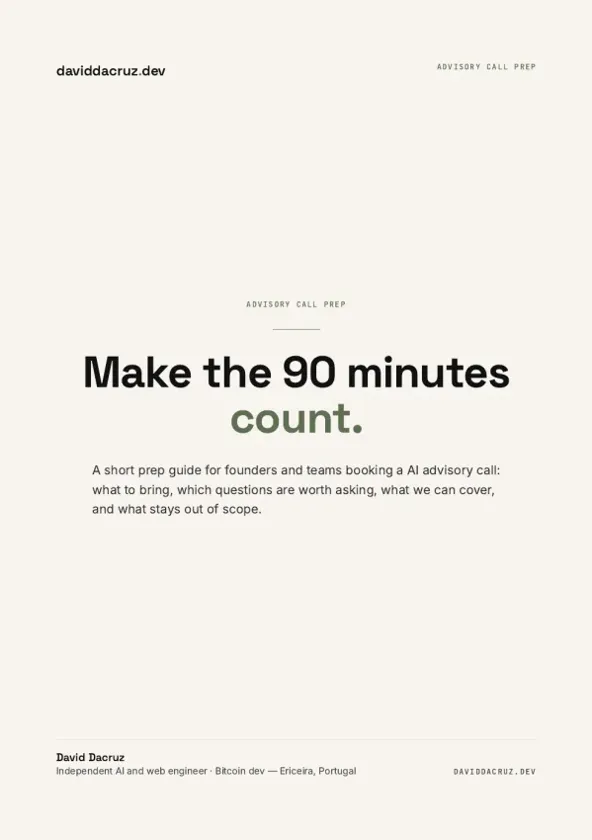
AI Advisory Call Prep Guide — PDF cover

Free PDF

AI Advisory Call Prep Guide

Make the 90 minutes count.

6 pages · PDF Inside:

  • A concise prep guide for founders
  • teams booking an AI advisory call: what to bring
  • which questions are worth asking
  • what we can cover
  • and what stays out of scope

Quick breakdown of the workflows, stack choices, and where the hours come back first.

Next step

Replies in ~24h

Want this mapped to your team and stack?

Use the advisory call to pressure-test the workflow, the handoff rules, and whether the first build should be a pilot or a production sprint.