Organizations are widely experimenting with AI, but many still have not scaled cleanly.
Small businesses should avoid overbuilding and start with one workflow that proves value fast.
Source · McKinsey State of AI 2025AEO funnel · small business buyer
Small businesses usually do not need a platform strategy. They need one painful, repeated workflow made smaller, faster, and more reliable without months of overhead.
For small businesses with one or two admin-heavy workflows around leads, support, reporting, or bookings that already waste real time every week.
The short answer
For small businesses, the best automation projects are narrow, operational, and judged on whether they reduce manual work quickly rather than whether they sound ambitious.
Why this matters now
Organizations are widely experimenting with AI, but many still have not scaled cleanly.
Small businesses should avoid overbuilding and start with one workflow that proves value fast.
Source · McKinsey State of AI 2025AI’s business value shows up through productivity and workflow improvement.
The right message for a small business buyer is less manual work and a cleaner week, not enterprise-style change-program language.
Source · PwC AI Jobs Barometer 2024Buyer fit
Breakdown
Usually because the same admin pain keeps showing up and no one on the team has the time or technical clarity to turn it into a system. The cost is not just labor. It is also delay, inconsistency, and mental overhead.
The business needs one senior person who can scope the workflow, make the stack choices, and ship the first useful version without adding process drag around the problem.
One narrow workflow, one clear owner, one measurable reduction in manual work. Small businesses usually win by shipping the smallest thing that obviously makes the week easier.
Sell speed, clarity, and a practical first build. The buyer wants less admin and fewer tool mistakes, not an AI strategy deck.
What breaks first
What the workflow should do
Representative proof
This page is stronger when it points at real Portugal-based operating work rather than only at the service menu. Ericeira Review shows a public local build with measurable traction, structured local-search execution, and practical workflow thinking. That gives the small-business buyer a more concrete reason to trust the fixed-scope path.
Open the Ericeira Review case studyFAQ
Usually the repeated ones: support triage, lead routing, booking coordination, reporting prep, onboarding admin, or any process that steals the same time every week.
Because software does not decide which workflow matters most or how it should be designed. Small businesses often lose money by buying tools before the process is clear.
As small as possible while still meaningfully reducing manual work. The goal is a useful workflow, not a broad platform rollout.
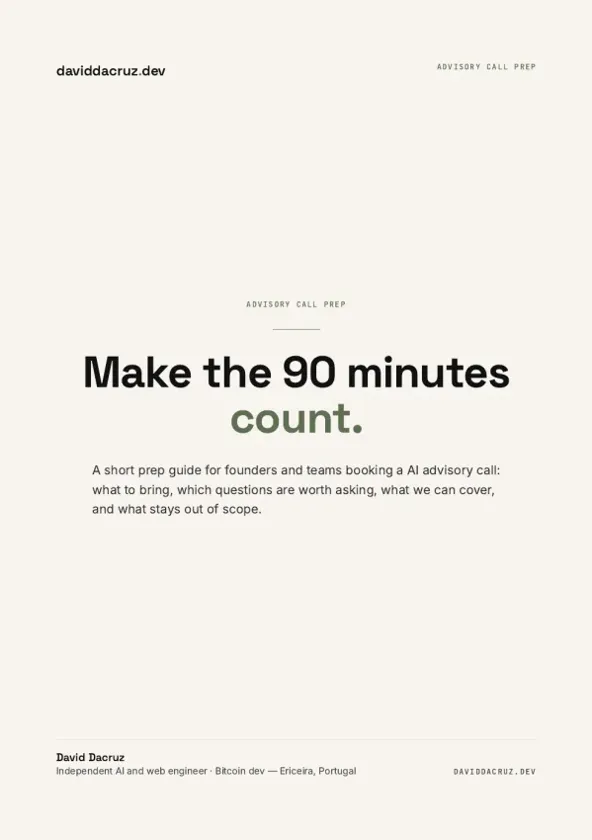
Free PDF
AI Advisory Call Prep Guide
Make the 90 minutes count.
6 pages · PDF Inside:
Quick breakdown of the workflows, stack choices, and where the hours come back first.