Skip to content

Definition · retention ops

What is churn detection?

Churn detection is the process of spotting which users, accounts, or customers are most likely to cancel, downgrade, or go inactive before that outcome is final. It is an early-warning system for retention work, not just a reporting layer.

The short answer

What matters most.

Useful churn detection changes behavior early enough to matter. If the signal arrives after the account has already disengaged, it is just a cleaner postmortem.

  • It combines usage, support, commercial, and sometimes sentiment signals into a retention warning system.
  • The best signal is one that triggers a useful action, not one that only looks smart in a dashboard.
  • Teams usually need simpler alerting and response logic before they need a complex predictive model.

Buyer fit

Best fit

  • • Subscription businesses where product usage, support, billing, or account-health signals already exist but are not being acted on quickly enough.
  • • Success or retention teams that need earlier warnings and clearer follow-up ownership.
  • • Operators who care more about actionable alerts than about a fancy predictive-retention narrative.

Not the best fit

  • • Businesses with no usable event data or no team available to intervene once risk is flagged.
  • • Teams expecting a churn score to solve retention without defining the response playbook.
  • • Very early products where customer behavior is still too inconsistent to model responsibly.

Breakdown

Common churn signals

Falling usage, skipped milestones, unresolved support issues, payment problems, low seat expansion, executive silence, and repeated negative sentiment can all be useful signals.

Where automation helps

Automation can watch events, flag accounts, score urgency, create tasks, draft outreach, and route risk alerts to the right owner before the account goes fully cold.

What teams get wrong

They build a predictive score before defining what intervention is actually supposed to happen when risk is detected.

What good looks like

The team sees risk earlier, reaches out with more relevant context, and can separate real at-risk accounts from accounts that just look quiet for normal reasons.

What breaks first

  • • The team realizes accounts are leaving only after the relationship is already cold.
  • • Useful risk signals exist across product, support, and billing systems but are not connected operationally.
  • • Retention effort is reactive and inconsistent because nobody sees the same warning set early enough.

What the workflow should do

  • • Combine the few signals that actually predict useful interventions instead of building a noisy dashboard.
  • • Route risk alerts to the owner who can act, with context attached.
  • • Measure whether detection changes outreach timing and save actions, not just whether a score looks statistically smart.

Representative proof

Churn detection is already positioned as an actionable workflow on the site

The churn-detection service page focuses on signal watching, account alerts, and team response logic. This definition page supports earlier discovery and helps frame the workflow in a way that operators and buyers can both understand.

Open the churn-detection service

FAQ

Does churn detection require machine learning?

Not always. Many teams get value first from rule-based risk alerts built from usage, support, and billing signals before a more complex model is needed.

What makes a churn signal useful?

It needs to arrive early enough to trigger a meaningful intervention and be specific enough that the team knows what to do next.

What usually matters more than model sophistication?

Clear ownership, response playbooks, and good signal hygiene usually matter more at the beginning than complex prediction architecture.
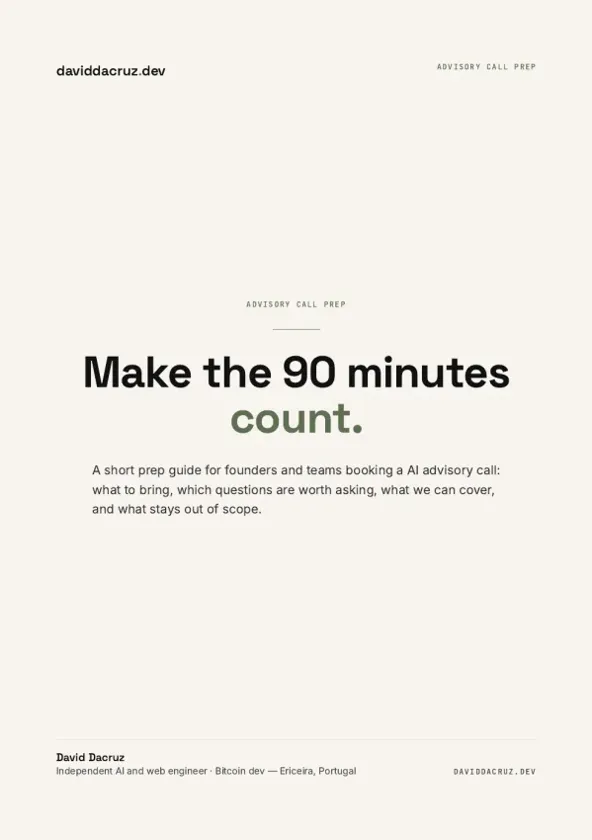
AI Advisory Call Prep Guide — PDF cover

Free PDF

AI Advisory Call Prep Guide

Make the 90 minutes count.

6 pages · PDF Inside:

  • A concise prep guide for founders
  • teams booking an AI advisory call: what to bring
  • which questions are worth asking
  • what we can cover
  • and what stays out of scope

Quick breakdown of the workflows, stack choices, and where the hours come back first.

Next step

Replies in ~24h

Need help deciding whether this is the right workflow to automate?

If the definition is clear but the implementation path is not, the advisory call is where I help map the workflow, the boundary, and the safest first build.