Skip to content

AEO funnel · SaaS onboarding

AI onboarding automation for SaaS

Use product and account signals to make onboarding feel relevant before a customer quietly stalls out.

Best fit for SaaS teams with enough activation friction that generic email sequences and static help docs no longer move the metric.

The short answer

What matters most.

Onboarding automation works when it reacts to real user and account signals. If the workflow cannot change the next message or task based on behavior, it is still just content delivery.

  • Best fit: SaaS products where new users stall for predictable reasons after signup.
  • Main job: detect onboarding risk, personalize the next message, and surface human intervention sooner.
  • The page should sell activation quality, not generic sequence automation.

Why this matters now

Knowledge workers are already using AI at work at large scale.

SaaS buyers are not waiting for permission to experiment. The commercial opportunity is to formalize one activation workflow that actually compounds.

Source · Microsoft Work Trend Index 2024
AI productivity value is clearest where workflows are information-heavy and repeatable.

Onboarding automation is attractive when customer signals, CRM context, and messaging rules can be combined into better next steps.

Source · PwC AI Jobs Barometer 2024

Buyer fit

Best fit

  • • PLG or hybrid SaaS teams where activation is measurable and stalls are visible in the data.
  • • CS or growth teams already looking at product signals manually before intervening.

Not the best fit

  • • Products with no reliable activation events or no clear definition of onboarding success.
  • • Teams wanting a fully autonomous customer success layer before the basics are instrumented.

Breakdown

Why generic onboarding stops working

Once product complexity rises, the same fixed sequence stops matching what users actually do. Some users need setup help, others need proof of value, and others need a human because the account is commercially important.

What the workflow should read

Signup source, account profile, product activation signals, missing setup steps, prior conversations, and team-defined risk markers. Those inputs are what make the next message feel earned rather than generic.

What automation should change

The next prompt, task, route, or escalation based on account behavior. If the message never changes, the workflow is still too shallow to justify the label.

How to sell it

Sell better activation signal handling and earlier intervention on at-risk accounts. Those are commercial outcomes that sit much closer to revenue than “more personalized onboarding” on its own.

What breaks first

  • • The team sees onboarding stalls too late because the signals are scattered.
  • • New users receive the same nudges regardless of where they are blocked.
  • • High-value accounts look the same as low-value accounts until a human intervenes manually.

What the workflow should do

  • • Use activation and account signals to change the next onboarding action.
  • • Escalate stalled high-value accounts before they quietly churn during setup.
  • • Give CS or growth one usable view of who needs help and why.

Representative proof

The service menu already supports this buyer intent

Onboarding automation is already a named service page in the site architecture. This page makes it easier to capture long-tail commercial searches around that exact workflow.

Open proof page

FAQ

What does AI add beyond normal onboarding sequences?

Signal-based adaptation. The workflow can change the next message, task, or escalation based on what the user and account have actually done.

Does this replace customer success?

No. It helps the team notice patterns earlier and reserve human time for the accounts and moments where judgment matters most.

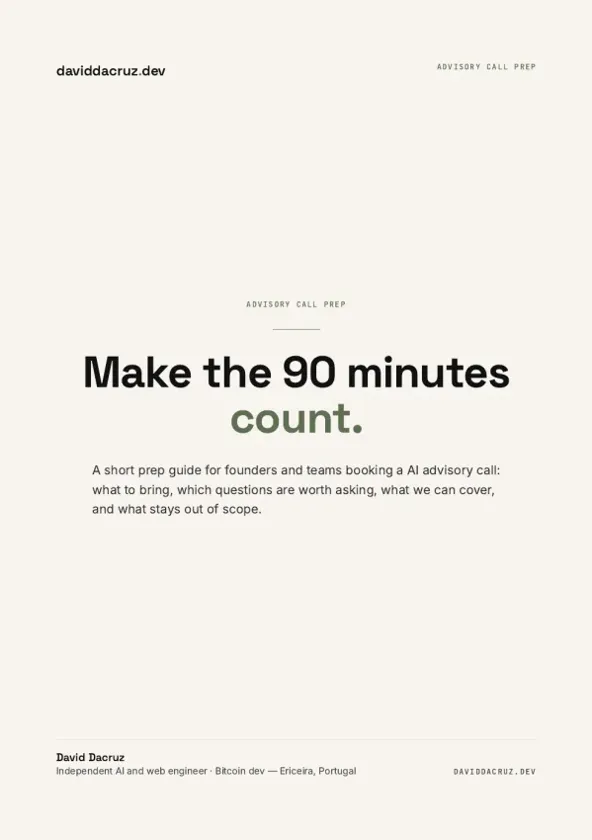
AI Advisory Call Prep Guide — PDF cover

Free PDF

AI Advisory Call Prep Guide

Make the 90 minutes count.

6 pages · PDF Inside:

  • A concise prep guide for founders
  • teams booking an AI advisory call: what to bring
  • which questions are worth asking
  • what we can cover
  • and what stays out of scope

Quick breakdown of the workflows, stack choices, and where the hours come back first.

Next step

Replies in ~24h

Want this mapped to your team and stack?

Use the advisory call to pressure-test the workflow, the handoff rules, and whether the first build should be a pilot or a production sprint.